
Connect


Friday, March 29, 2013

Wednesday, March 27, 2013
Reading Too Much Into Serendipity
Serendipity is one of those "tech can't copy it" things often sited by people clinging to the-way-things-were.
And there is serendipity in libraries and book stores. There's a lot of fun to be had finding books. But that's only for people who have a wide enough reading palette to enjoy a variety of books. I think that most readers pick their books for comfort, so they're not really interested in discovery.
That's why bookstores are failing across the country, why Amazon's suggestion logarithms do more business than libraries. We just aren't interested in reading much.
And I wonder if the internet doesn't offer the deeply engaged reader as many opportunities for discovery as the book store. Sure, if you're ruling out every recommended read and every suggested title as unserendipitous, sure that doesn't leave much else. But looking at it another way, every book reviewer is a book seller.
I wonder if that isn't really better in the long run.
Friday, March 22, 2013
Review: Oryx and Crake by Margaret Atwood
On the same road trip when I listened to The Year of the Flood, I also listened to Margaret Atwood's Oryx and Crake.
 Maybe it was too much dystopia, or maybe I just spent too much time in the car (hello Pittsburgh!), but Oryx and Crake wasn't as riveting.
A lot of my enjoyment of a book comes from the narrator. Even if I didn't always love both narrators of Year of the Flood, they were distinct, and the point of view shifted often enough to keep one voice from going stale. In Oryx and Crake, we have only the voice of Snowman, gone mad with loneliness and grief.
Having read Year of the Flood first, the fact that Snowman is the only narrator also tips the author's hand that there will be no other people in this book. Much more than Robinson Crusoe or The Shining, Oryx and Crake is about what it's like to be the last man on Earth.
Oryx and Crake also suffered from the prequel problem (since I listened to the two books out of order): there were plenty of mysteries in the first book, and they don't all have to be explained away. Trying to understand without knowing is a part of life, and it's a part of the best fiction. Many of the scenes in Oryx and Crake I would have been most willing to cut involved the development of the technology that was taken for granted in Year of the Flood like ChickieNobs and pigoons.
Much like knowing the ending to a mystery novel, knowing a piece of the ending sapped some of the joy from Oryx and Crake. I'm not sure what I was hoping for, but I'm sure I didn't get it.
Monday, March 18, 2013
Review: Year of the Flood by Margaret Atwood
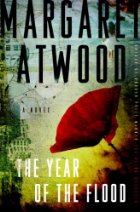
The Year of the Flood is about the end of the world. While the book's structure is divided between the time before and the time just after a pandemic that pushes the human race to the brink of extinction (the "waterless flood" the novel's religious zealots warn about), human life was over long before the disease's outbreak.
Atwood writes about people trying to build a life in the ruins of civilization. As power and wealth concentrates to the elite few, how do the rest of us forge a life? Can you get a decent job, find a decent place to live, raise a family? Through the eyes of two survivors, Toby and Ren, Atwood shows us a world in which the corrupting power of oligarchy's decadence and self-service rips civilization apart.
Sunday, March 17, 2013
Going Back to Goodreads
 One of my 30 Before 30 goals is to improve the blog layout. While it isn't exactly an adjustment to my site, last night I finished importing all my reviews on this blog and LibraryThing to Goodreads.
I got onto Goodreads years ago (seriously, the first book I added was East of Eden on July 11, 2007). Back then, I didn't like it. It was clunky and slow, and it didn't do a good job of sorting through multiple editions. Just because I read one version of Pride and Prejudice doesn't mean I need 1000 versions in my library.
When I started blogging about books, I discovered LibraryThing. It had a much smoother interface than I remember from Goodreads, and the site is small enough that I've actually won a few books from their give-away program. But smallness is a disadvantage, too. I'm not leaving LibraryThing, but with 21 million members, Goodreads is where the people are.
If I'm going to properly serve myself in promoting my reviews, and serve the publishers and authors who have sent me books, I've got to reach the biggest audience possible.
So, whichever site you prefer, let's connect.
Goodreads
LibraryThing
Friday, March 15, 2013
Subscribe to:
Posts (Atom)