I dragged myself through Reading Lolita in Tehran by Azar Nafisi as part of the Freshman Reading Experience at the school where I work. The students I met with didn't even make it that far.
I wonder a lot about this book. The students Dr. Nafisi spend so much time with are obviously important to her. And, from a sociological standpoint, their struggle to create a personal space in the midst of one of the most oppressive regimes on Earth certainly has value.
But Dr. Nafisi's attempt to bring that struggle to life through the works of Nabokov, Fitzgerald, Austen and James left me cold. Reading Lolita in Tehran struggled to find its own identity- not quite enough about books and their ideas to captivate me, not quite enough a personal memoir to become open and accessible. Perhaps it is the most accessible book of its kind, but that is being damned by faint praise.
The thing RLiT lacked most was a definitive moment of choice. It was, instead, a study in the daily struggle of life in a totalitarian state. Of course, this makes it true in a way literature can rarely afford to be true. I think of Saul Bellow's Dangling Man as the distillation of the Superfluous Man, and in RLiT, Nafisi repeatedly refers to herself as "irrelevant," a superfluous woman in a country violently opposed to her kind of womanhood.
This lack of "moment" christalyzed into repetition and self-referentialism. Some of her stories are repeated with little variation. Some of her ideas (like her irrelevance) are referenced several times before they are expanded on and explained. While the book mostly flows forwards chronologically, it takes occasional leaps that make it difficult to follow.
It didn't help my experience that I listened to most of the book while taking a trip for work. The audiobook is atrocious; the narrator speaks so slowly that the less than 400 pages of the book take 16 hours to trudge through.
Wednesday, August 28, 2013
Friday, July 5, 2013
Happy Friday
“Discipline 'makes' individuals; it is the specific technique of a power that regards individuals both as objects and as instruments of its exercise. It is not a triumphant power...it is a modest, suspicious power, which functions as a calculated, but permanent economy.”
Monday, December 31, 2012
Class Warfare in The Loneliness of the Long-Distance Runner by Alan Silltoe
| from here |
It's hard not to read Alan Sillitoe's The Loneliness of the Long-Distance Runner through the prism of our American fiscal cliff.
In story after story of this slim collection, the lower class Britons on the eve of the Second World War slouch from birth to death. They make terrible choices for lack of options across nine stories: robbery; a fight between a teacher and student; a man kindly assists his ex-wife in drinking herself to death; two boys beg, lie and steal to scrape together enough money to enjoy a fair; a man hangs himself with the help of a young boy; one man alleviates the misery of his life by beating his wife and children, while another exposes himself to little girls.
In the cruelest story of them all, "Uncle Ernest," the title character (a hard working upholsterer) finds joy in his hand-to-mouth existence by caring for two young girls. It's unclear if they needed his care: their mother has a job, and they go to school. When they first meet Ernest, they have the money for the bus ride home from a small cafe. Still, they accept his charity- he goes hungry and runs up debt to buy them tea and sweets. In kindness, he finds companionship and a hollow measure of happiness. The world, of course, punished him for that. A pair of coppers show up, responding to complaints or questions- some people thought the little girls were taking advantage of the old man's generosity. The police, acting on the best behalf of society, accuse him of untoward acts that have never crossed his mind, and they finally fling him into the street with orders to never contact the girls again. Uncle Ernest retreats to a bar, for the only escape society allows him.
This is how the world ends.
Wednesday, November 28, 2012
Book Review: The Southern Tiger by Ricardo Lagos
| from here |
What do you know about Chile under and after the reign of Augusto Pinochet? Too much or too little.
I came to Lagos' book knowing these things:
1) Pinochet ruled Chile in the modern autocratic fashion, by pretending to have been elected;
2) He came to power in the '70s, backed by the US amid a string of disastrous Cold War medling with South American politics, and he ruled into the late '80s;
3) He died in 2006, having never been punished for the war crimes he committed against the people of Chile.
The first third of Lagos' book was exactly what I had hoped for from the former opposition leader and Chilean president- an insider's account of the movement to oust Pinochet, and pride for the peaceful and democratic process that followed that transition. Lagos presents himself as (and may feel himself to have been) a key leader in the opposition, but his positions in the first post-Pinochet coalitions make him look more an observe of history, rather than a shaper of history. Still, that transition seems so much more remarkable as I watch the violent aftermath of the Arab Spring, of the collapse (re-collapse?) of the Congo, of the drug lords turning Mexico into a failed state to expedite their with the United States. Souther Tiger may suffer, after all, from a politician's gloss on history, but that doesn't diminish, for the me, the importance of that history.
The final third of Southern Tiger was just as eloquent- an idealogical manifesto for the future of Chile and the world, with (of course) Lagos' socialist slant at its core.
The middle section, though... I just lost interest. My limitation are no small part of the problem- reviewing Lagos' time in government after Pinochet was just too much inside baseball. With no prior knowledge of Chile's domestic struggles or dreams, I have no way to contextualize, no way to appreciate Lagos' achievements, nor do I have any knowledge of his failings. But the story also lacked a grand vision, a unifying arc to make Chile's struggles compelling to a foreigner.
Ultimately, Southern Tiger was a political memoir, neither the best nor the worst I've read in that genre. A fine enough book, but the wrong book for me.
Book 42 of my book-a-week challenge.
Saturday, September 29, 2012
The BFG and The Hunger Games, Locke and Hobbes
In the last few weeks I've read several books, all of which I intend to review.
But I keep circling around these two children's books: The BFG (by Roald Dahl) and The Hunger Games (by Suzanne Collins).
A strange combination, I suppose. I didn't intend to read them in succession, and I'd never read them before. I didn't know a thing about BFG until my wife brought it along as an audio book for one of our road trips. On the other hand, I'd heard all about The Hunger Games. Expectations are funny things. Friends of mine, people who know me but must not really know what I read (and why), kept recommending Hunger Games. And I kept resisting. I know myself.
I enjoyed Harry Potter, but I didn't read it until all the books had been published, and I came very close to not finishing the series. I blew through the first 3 books and promised myself that if the fourth book didn't pick up considerably, I was finished. Thankfully, the fourth book improved in the complexity of its plot, the depth of its characters, and its tenor. But Harry Potter was an exception to this simple rule: Young Adult books are too simple.
And Hunger Games was. Of course, I see (or think I see) all the injustices the author wants us to see: the brutality of wealth, the disenfranchisement of the oppressed, the divisions within the oppressed that prevent an overthrow of the system.
BFG traffics in many of the same themes: we meet monsters who force us to admit that our "civilization" is barbaric in its own ways, we see how hard it really is for someone who perceives him or herself as weak to stand up to thuggery.
Both protagonists are young girls snatched from their homes and put in a hostile environment. Food is central to both books (the hunger games tournament revolves around the threat of starvation, while the giants of BFG show their evilness by guzzling humans).
But where the prose of Hunger Games felt static and lifeless (in fairness, largely because the bulk of the book was exposition by a character who is profoundly isolated from the people around her; it would be interesting to see how similar internal books fared in movie adaptations), BFG was brimming with dialogue. The voice of the giant who is the focus of BFG is unique, in the same fractured syntactical way that so many of Lewis Carrol's characters are.
In the denouement of both Hunger Games and BFG, our protagonists realize how their previous view of the world was too simple, that the real world is more complex than they had considered. But where Katniss raises her guard and begins to see enemies everywhere, Sophie finds friends. Maybe its wishfulness, the mix of nostalgia and childishness, that makes me prefer Sophie's ending.
The people of Sophie's world are, ultimately, good people. They are competent and capable. Though they need help to see past differences, with a little guidance from a young girl, they can. Katniss' world is darker, more filled with people willing to sacrifice each other. Thinking about the political science distinction between Locke and Hobbes, whether we are social creatures who come into conflict only when we delude ourselves into thinking that force is justified by the scarcity of resources, or whether we are individualists only bound together by the strictures of society.
I've always come down in favor of Locke- just as I prefer Dahl to Collins.
Books 35 and 36 of my book-a-week challenge.
But I keep circling around these two children's books: The BFG (by Roald Dahl) and The Hunger Games (by Suzanne Collins).
A strange combination, I suppose. I didn't intend to read them in succession, and I'd never read them before. I didn't know a thing about BFG until my wife brought it along as an audio book for one of our road trips. On the other hand, I'd heard all about The Hunger Games. Expectations are funny things. Friends of mine, people who know me but must not really know what I read (and why), kept recommending Hunger Games. And I kept resisting. I know myself.
I enjoyed Harry Potter, but I didn't read it until all the books had been published, and I came very close to not finishing the series. I blew through the first 3 books and promised myself that if the fourth book didn't pick up considerably, I was finished. Thankfully, the fourth book improved in the complexity of its plot, the depth of its characters, and its tenor. But Harry Potter was an exception to this simple rule: Young Adult books are too simple.
And Hunger Games was. Of course, I see (or think I see) all the injustices the author wants us to see: the brutality of wealth, the disenfranchisement of the oppressed, the divisions within the oppressed that prevent an overthrow of the system.
BFG traffics in many of the same themes: we meet monsters who force us to admit that our "civilization" is barbaric in its own ways, we see how hard it really is for someone who perceives him or herself as weak to stand up to thuggery.
Both protagonists are young girls snatched from their homes and put in a hostile environment. Food is central to both books (the hunger games tournament revolves around the threat of starvation, while the giants of BFG show their evilness by guzzling humans).
But where the prose of Hunger Games felt static and lifeless (in fairness, largely because the bulk of the book was exposition by a character who is profoundly isolated from the people around her; it would be interesting to see how similar internal books fared in movie adaptations), BFG was brimming with dialogue. The voice of the giant who is the focus of BFG is unique, in the same fractured syntactical way that so many of Lewis Carrol's characters are.
In the denouement of both Hunger Games and BFG, our protagonists realize how their previous view of the world was too simple, that the real world is more complex than they had considered. But where Katniss raises her guard and begins to see enemies everywhere, Sophie finds friends. Maybe its wishfulness, the mix of nostalgia and childishness, that makes me prefer Sophie's ending.
The people of Sophie's world are, ultimately, good people. They are competent and capable. Though they need help to see past differences, with a little guidance from a young girl, they can. Katniss' world is darker, more filled with people willing to sacrifice each other. Thinking about the political science distinction between Locke and Hobbes, whether we are social creatures who come into conflict only when we delude ourselves into thinking that force is justified by the scarcity of resources, or whether we are individualists only bound together by the strictures of society.
I've always come down in favor of Locke- just as I prefer Dahl to Collins.
Books 35 and 36 of my book-a-week challenge.
Thursday, August 9, 2012
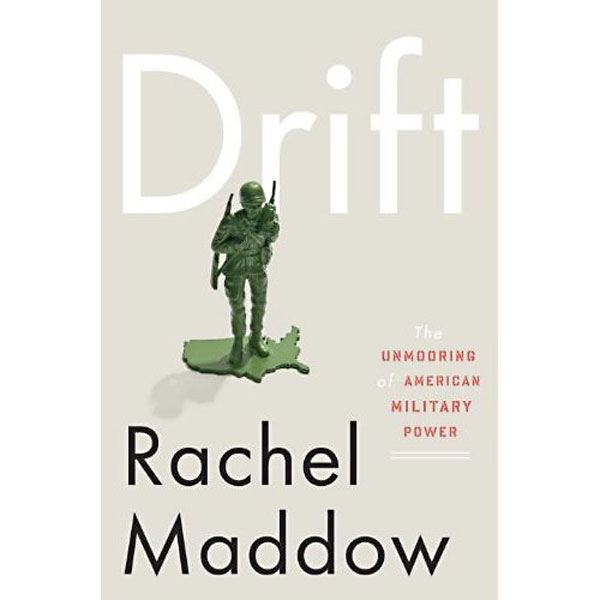
Drift by Rachel Maddow, Book Review
| from here |
America is in a weird place in regards to its military right now, and Maddow makes a compelling case that our historical moment is unique and the unintended consequence of a series of well intended decisions.
We have an all volunteer force, a political necessity as part of the post-Vietnam reaction to the draft. But part of the reason that Vietnam War dragged on was because the draft, at that point, had been watered down with exemptions. By allowing so many young men out of military service, we lessened the war's impact at home.
We've continued this trend in the years since: outsourcing security details to mercenaries like Blackwater, issuing stop-loss assignments for members of the National Guard, and acting at home (from a policy perspective) as though we're not at war abroad.
Tuesday, February 7, 2012
Deciding What to Fight, How and Why
I often disagree with what I read in David Brooks' columns in the NYTimes, but I (almost) always find his columns articulate, thoughtful and engaging. His column from February 2, How to Fight the Man, is no exception, and a particular passage has been echoing around in the back of my head:
In America, I'm thinking specifically of the various Occupy movements and the frustration stimulating the Tea Party, while abroad I'm thinking of the latest round of protests and the violent government reaction to the protests in Syria, Egypt, Russia and China. From everything I hear and read, there are undercurrents of a mantra claiming 'the system cannot be transformed or reformed, it must be entirely circumvented.' While there is no compromise and no negotiation, this refusal to articulate demands is not a form of nihilism; the unifying force behind the many revolutions is the conscious dismantling of the weapons used by institutions of power to pay lip service to reform.
In less public arenas, there are thousands of people trying to find ways to live the revolution. The proliferation of urban farmers and barter networks has been fueled by the belief that our current system is too deeply entrenched, too powerful, too seductive to change. For the modern revolutionaries, we live simultaneously in and around the capital-imperialist structure of the world. Having decided to fight "the man," we employ a strategy of non-engagement in hopes of avoiding being sucked back into the traditional power dynamics that subsumed each revolution from the Bolsheviks to the Beatniks to Flower Children to the Monday Demonstrations.
For one of these new style revolutions to be successful (and I doubt any one of them will, but perhaps the aggregate influences on our culture will give birth to the conditions to a genuine revolution) the revolution will have to grow in an organic way, one that historians can chart backwards through time, the way we chart the American Revolution back to the Enlightenment ideals of John Locke a century before, and back through European history to the Magna Carta. The revolution will be slow, but because it is slow, it might be complete.
The paradox of reform movements is that, if you want to defy authority, you probably shouldn’t think entirely for yourself. You should attach yourself to a counter-tradition and school of thought that has been developed over the centuries and that seems true.In general, I would agree with Brooks that a revolution must be empowered by a belief in something that allows the revolutionaries to see the world as it should be, rather than as it is. But I think he misses a crucial piece of zeitgeist: the conjoining philosophies of many modern revolutionaries is a disbelief in the power of revolution, particularly in the pattern of revolutions overthrowing one order to establish a "new," all too similar, order.
...
These belief systems helped people envision alternate realities. They helped people explain why the things society values are not the things that should be valued. They gave movements a set of organizing principles. Joining a tradition doesn’t mean suppressing your individuality. Applying an ancient tradition to a new situation is a creative, stimulating and empowering act. Without a tradition, everything is impermanence and flux.
In America, I'm thinking specifically of the various Occupy movements and the frustration stimulating the Tea Party, while abroad I'm thinking of the latest round of protests and the violent government reaction to the protests in Syria, Egypt, Russia and China. From everything I hear and read, there are undercurrents of a mantra claiming 'the system cannot be transformed or reformed, it must be entirely circumvented.' While there is no compromise and no negotiation, this refusal to articulate demands is not a form of nihilism; the unifying force behind the many revolutions is the conscious dismantling of the weapons used by institutions of power to pay lip service to reform.
In less public arenas, there are thousands of people trying to find ways to live the revolution. The proliferation of urban farmers and barter networks has been fueled by the belief that our current system is too deeply entrenched, too powerful, too seductive to change. For the modern revolutionaries, we live simultaneously in and around the capital-imperialist structure of the world. Having decided to fight "the man," we employ a strategy of non-engagement in hopes of avoiding being sucked back into the traditional power dynamics that subsumed each revolution from the Bolsheviks to the Beatniks to Flower Children to the Monday Demonstrations.
For one of these new style revolutions to be successful (and I doubt any one of them will, but perhaps the aggregate influences on our culture will give birth to the conditions to a genuine revolution) the revolution will have to grow in an organic way, one that historians can chart backwards through time, the way we chart the American Revolution back to the Enlightenment ideals of John Locke a century before, and back through European history to the Magna Carta. The revolution will be slow, but because it is slow, it might be complete.
Thursday, October 27, 2011
Student loan reform
While this blog isn't really intended to be a political blog, it is a receptacle for my stray thoughts.
So when I saw this tidbit on President Obama using an executive order to help new and recent graduates cut down the amount they owe on their student loans, I had two thoughts (actually, by the time I finish writing it's likely to be more than two thoughts).
First, the details:
I wish this had been an option for me.
While my student debt is not crushing (locked in around $120 per month) it does feel interminable: I'll be paying that for the next 28 or so years. I assume I didn't qualify for the "Pay as You Earn" option when I was in college ('02-05, grad '06-07), because no one ever told me about it. But I also don't feel like I'd ever heard of the option.
(This is a fairly major concern for me, because I definitely think that education and information are the two things most lacking in this country at the moment.
For example, people believe that cutting taxes to increase corporate profit can help the economy, and because they believe this to be true, they want it to happen; but the only reason they believe it is because someone(s) with the platform and the incentive to provide false or misleading information has chosen to abuse a bully pulpit. Those with the money [read: corporations and billionaires] have almost unilateral control over the education of the majority of Americans.
If I could do 1 thing to transform the country, it wouldn't be reforming the tax code or shattering the 2 party system: I would break up the major news corporations. I would enforce the [almost always waived] prohibition on a single corporation owning multiple outlets and multiple platforms. I would require news outlets to run prominent corrections when fact-checked by independent reviews and auditors like Media Matters.)
Thought 2:
About damn time.
I'm a little worried by the precedent, and by the question of who will hold those bills, but at this point, who really cares?
The cost of a first class education has far outpaced the growth in earning power that degree confers, and something has to be done. Personally, I'd prefer a world where we accept that not all learners are best served by a 4 year degree, where community colleges and trade schools do the major work of career educations, where the value of a degree is not so watered down that more and more fields expect graduate work for entry-level to mid-level positions.
Since that world is unlikely to develop in the next month or so, this is the next best solution: demand of those who are most likely to default (and, therefore, contribute nothing towards the cost of their education) a reasonable share of their earnings for a very long time (for most of them, longer than they were alive before they made the decision to take on the education debt).
So when I saw this tidbit on President Obama using an executive order to help new and recent graduates cut down the amount they owe on their student loans, I had two thoughts (actually, by the time I finish writing it's likely to be more than two thoughts).
First, the details:
the president would use his executive authority to expand the existing income-based repayment program with a “Pay as You Earn” option that would allow graduates to pay 10 percent of their discretionary income for 20 years and have the rest of their federal student loan debt forgiven.Thought 1:
I wish this had been an option for me.
While my student debt is not crushing (locked in around $120 per month) it does feel interminable: I'll be paying that for the next 28 or so years. I assume I didn't qualify for the "Pay as You Earn" option when I was in college ('02-05, grad '06-07), because no one ever told me about it. But I also don't feel like I'd ever heard of the option.
(This is a fairly major concern for me, because I definitely think that education and information are the two things most lacking in this country at the moment.
For example, people believe that cutting taxes to increase corporate profit can help the economy, and because they believe this to be true, they want it to happen; but the only reason they believe it is because someone(s) with the platform and the incentive to provide false or misleading information has chosen to abuse a bully pulpit. Those with the money [read: corporations and billionaires] have almost unilateral control over the education of the majority of Americans.
If I could do 1 thing to transform the country, it wouldn't be reforming the tax code or shattering the 2 party system: I would break up the major news corporations. I would enforce the [almost always waived] prohibition on a single corporation owning multiple outlets and multiple platforms. I would require news outlets to run prominent corrections when fact-checked by independent reviews and auditors like Media Matters.)
Thought 2:
About damn time.
I'm a little worried by the precedent, and by the question of who will hold those bills, but at this point, who really cares?
The cost of a first class education has far outpaced the growth in earning power that degree confers, and something has to be done. Personally, I'd prefer a world where we accept that not all learners are best served by a 4 year degree, where community colleges and trade schools do the major work of career educations, where the value of a degree is not so watered down that more and more fields expect graduate work for entry-level to mid-level positions.
Since that world is unlikely to develop in the next month or so, this is the next best solution: demand of those who are most likely to default (and, therefore, contribute nothing towards the cost of their education) a reasonable share of their earnings for a very long time (for most of them, longer than they were alive before they made the decision to take on the education debt).
Subscribe to:
Posts (Atom)