In Monster on the Hill, Rob Harrell of Top Shelf has put together a story that is begging to be turned into a Pixar film.
The monster Rayburn isn't particularly excited about his job terrorizing the people of Stoker-on-Avon. But terror is big business in this Victorian world, and the town fathers enlist a local inventor to prod Ray into action. With a tag along urchin in tow, the trio set out to visit one of Ray's old school buddies to help restore Ray's self-confidence.
Unfortunately, while out of town, a real monster shows up. Ray and his friends must race back to Stoker-on-Avon to deal with the crisis.
A children's story with the right mix of morals and hijinx, my favorite part of Monster on the Hill was the brilliantly drawn world Ray and his friends inhabit. With bold colors and odd shapes, Harrell builds a Seuss-like world filled with quirks and just enough magic to keep the readers on their toes.
Tuesday, December 17, 2013
Wednesday, October 23, 2013
Review: Hutch by Shannon and Hannig
While the Pirates rolled over the Reds on Tuesday night, I read Mike Shannon and Scott Hannig's graphic novel biography of Fred Hutchinson, Hutch.
An under-appreciated pitcher in his era, Hutch boasted great command but never racked up enough wins to garner more than a single All-Star appearance. His Tigers teams of baseball's golden age were overshadowed in the American League by the Yankees, who would take the pennant in seven of Hutch's ten seasons. In the only World Series appearance of his career, at age 20, he pitched one inning, gave up a homerun and walked a batter.
Clearly, this is the story of a good man who never stood at the peak of his craft, but who loved the game and worked hard anyway. He'd become a player-manager with the Tigers, and then win Manager of the Year for the Cardinals. Then, he'd lead the Cincinnati Reds to the 1961 pennant. But the Yankees in '61 where the Yankees of Mantle and Maris, and the Reds would lose in five games. That was Hutch's last pennant; in the spring of 1964, he'd share with the world that he was battling lung cancer, and 3 weeks after the end of the season, he died. Baseball would create the Hutch Award in his memory.
Thursday, September 26, 2013
Review: Evil Diva, Volumes I and II
The folks at Angry Viking Press sent me a copy of the first book in their Evil Diva series. Written by Joe Cashman and Peter Menotti, it's drawn by Stephen Hood and "Team Diva." It's fascinating, playing with tv sitcom tropes set in a middle school in the same nimble and bright way that the award winning American Born Chinese did.
Diva is a devil at a high school for angels and devils; like the four houses of Harry Potter's Hogwarts, St. Swithern's School is an impossible thing that functions for the sake of the story. It gives our devil a place where she can be too good. Luckily, she's quickly taken under the wing of the school guidance councilor, Virgil, who passes on a mysterious wand. Family friendly hijinx ensue as Diva begins a secret life as a do-gooding superhero, while also searching for a chance to "do things her own way" in her real life. The book cliff-hangs to promise many future installments as Diva works around the expectations of the other characters in the story and finds her own place in the world.
Friday, May 31, 2013
Review: A Matter of Life by Jeffrey Brown
When I was first discovering that there were graphic novels out there that dealt with real life, not superheroes and spandex, but everyday life, one of the best books I came across was Jeffrey Brown's Clumsy. That Clumsy was about the difficulties and awkwardness of long distance relationships a topic I know a little about, only made it feel more true.
So I was thrilled when the folks over at Top Shelf gave me to the chance to review Jeffrey Brown's A Matter of Life, which comes out next month.
A Matter of Life is about Brown's struggle with religion, his parent's faith and their refusal to reject him despite his rejection of faith. Where Craig Thompson's Blankets is about the breaking of relationships over faith (and, in that way, echoes Portrait of the Artist as a Young Man's bildungsroman), Brown's life never seems particularly ruffled by his decision. Of course, there is some tension and there are awkward moments. But on the whole, Brown's life is happy, good, normal. A normal life isn't usually best-seller material, but when the story is told as honestly as Brown tells it, normal life becomes compelling.
So I was thrilled when the folks over at Top Shelf gave me to the chance to review Jeffrey Brown's A Matter of Life, which comes out next month.
A Matter of Life is about Brown's struggle with religion, his parent's faith and their refusal to reject him despite his rejection of faith. Where Craig Thompson's Blankets is about the breaking of relationships over faith (and, in that way, echoes Portrait of the Artist as a Young Man's bildungsroman), Brown's life never seems particularly ruffled by his decision. Of course, there is some tension and there are awkward moments. But on the whole, Brown's life is happy, good, normal. A normal life isn't usually best-seller material, but when the story is told as honestly as Brown tells it, normal life becomes compelling.
Labels:
autobiography,
books,
graphic novels,
non-fiction,
reading,
topshelf
Monday, May 13, 2013
Review: Archeologists of Shadows by Lara Fuentes and Patricio Clarey
Is it despite or because of Archeologists of Shadows: The Resistance's slick graphics that it reminds me of a video game?
RPGs are one of my favorite forms, but they (almost) all follow the same trope: we, the heroes, dive into the world and are slowly introduced to its key elements. We are Neo, and we need a Morpheus to walk us slowly through the game mechanics. We are Frodo, lost if not for Strider's explanations It's a trope underscoring one of the great weaknesses of science fiction- as the world becomes more unrecognizable, the author's impulse is to explain. And Archeologists is, at times, unrecognizable from the modern world, a cyberpunk alternative to The Matrix, where humanity has become the machines.
The really great works of science fiction simply pull us headfirst into the world, knowing we'll pick it up as we go along. For all of the (just) criticism leveled against George R. R. Martin's Song of Ice and Fire (sorry to have brought it up in successive posts), one thing it does well is trusting the reader to swim along in a cascade of information. This is why the story is so much more illuminating upon re-reading. Habibi, Ender's Game, Slaughterhouse Five; these books never really worry that the reader won't get it, they just plow on through.
Fuentes and Clarey strike a middle path. That the main characters of Archeologists of Shadows stumble through their world, finding just the right combination of wary but helpful strangers, nearly made me set the first volume aside. That their success appears to have been part of a more elaborate scheme by the hegemonic enemy sets up quite the Chekov's Gun. Either Fuentes and Clarey have a masterpiece or a dud; if there is a payoff waiting worthy of the immense cliffhangers provided by this first volume, this will be a series worth digging into.
Friday, May 10, 2013
Review: Akira by Katsuhiro Otomo
Of course, if you made it to the Open Mic, you already know what I've been re-reading.
I read a lot of memoirs in graphic novel form, and that is not what Katsuhiro Otomo's Akira is.
For all that made it groundbreaking in the 1980s (one of the first manga to be translated into English), volume one of Akira is also a throwback. The sound effects leap off the page like the old Batman live action tv show. The set-up is classic comic: young men, apparently still in school but independently resourceful enough to operate a drug dealing motorcycle gang, stumble their way into an adventure that unfolds slowly enough for them to figure out most of what's going on without any of main characters coming to serious harm.
Fandom has given a lot of attention to how numbing the violence becomes in George R. R. Martin's Song of Ice and Fire (and especially the novels after Game of Thrones). And while it's true (for me, at least) that I find it annoyingly disengaging to see Martin kill off major characters just as the readers have gotten to know them well enough to become attached, I also find it ridiculous to see multiple characters survive a dozen close calls within the span of a few hundred panels.
Because of this disinterest in the plot, I've never gotten around to buying volume two of Akira. But on re-reading, I found enough to like that I'm reconsidering my position. Especially in Otomo's framing and shading, and most especially in his speed lines, I find a lot to hold my attention on each page.
I read a lot of memoirs in graphic novel form, and that is not what Katsuhiro Otomo's Akira is.
For all that made it groundbreaking in the 1980s (one of the first manga to be translated into English), volume one of Akira is also a throwback. The sound effects leap off the page like the old Batman live action tv show. The set-up is classic comic: young men, apparently still in school but independently resourceful enough to operate a drug dealing motorcycle gang, stumble their way into an adventure that unfolds slowly enough for them to figure out most of what's going on without any of main characters coming to serious harm.
Fandom has given a lot of attention to how numbing the violence becomes in George R. R. Martin's Song of Ice and Fire (and especially the novels after Game of Thrones). And while it's true (for me, at least) that I find it annoyingly disengaging to see Martin kill off major characters just as the readers have gotten to know them well enough to become attached, I also find it ridiculous to see multiple characters survive a dozen close calls within the span of a few hundred panels.
Because of this disinterest in the plot, I've never gotten around to buying volume two of Akira. But on re-reading, I found enough to like that I'm reconsidering my position. Especially in Otomo's framing and shading, and most especially in his speed lines, I find a lot to hold my attention on each page.
Wednesday, May 1, 2013
Review: Marbles by Ellen Forney
Forney's pages have a rich variety. When framed, her pages are regularly three row, usually two column but occasionally mixing in a page-width row. When unframed, her images and words spill over each other. The more manic the scene, the more disordered the framing. My favorite image comes at the end of the third chapter- a sideview of a black drain, with an image sliding down one side. Is it water, or is it a three part liquified stick figure melting away? On one side of the drain is a long list of the negative side effects and risks of lithium use. On the other side is the sober reality that lithium wasn't the best drug for her at that moment. As a story teller, Forney balances her text-heavy tale with great, often brilliant black and white art.
Labels:
autobiography,
books,
graphic novels,
literature,
non-fiction,
reading
Tuesday, February 26, 2013
Review: Heck by Zander Cannon
The good folks at Top Shelf Comix sent me an advanced galley of Zander Cannon's Heck, which I'll try to review without too many puns. The following phrases have been purged from this review during editing: hell of an adventure, many layered exploration, lingers like hell.
Heck is Cannon's first graphic novel (though he's a Harvey Award nominee for The Replacement God and Eisner Award winner, with Alan Moore and Gene Ha, for Top Ten). He also worked in a Prairie Home Companion reference into his bio.
The plot is straight-forward: Hector "Heck" Hammarskjöld is the estranged son of a sorcerer, who finds a gateway to hell in dad's basement, then decides to take up the adventuring life, acting as an abyssal currier service for grieving mortals who want to ask one last question of the dead.
Tuesday, January 22, 2013
Maus by Art Spiegelman
Art Spiegelman's Maus was one of the most difficult graphic novels I've ever read.
Not difficult because of the subject material- though it's hard to think of a book about the Holocaust as light reading.
Maus is hard to read because it's literarily hard to read. The colorless frames have very little gray; what might seem to be gray at first glance is in fact minutely cross-hatched black and white. This leaves the eye (or, at least, my eye) very little time to rest.
As a story about storytelling, hardly a frame goes by without a word in it, and in most frames, the words overlow. The dialogue bubbles interfere with the images; there's just not enough room for the words and images to co-exist. If that's not trouble enough, Spiegelman's hand printed writing slants and tumbles just enough to make it impossible to scan. Every page is a labor (and maybe it's supposed to be that way).
While the anthropomorphized animals might give a reader the emotional distance to deal with the tragedy (and while Jews-as-mice, Nazis-as-cats motif might help a grade school student keep track of good guys and bad guys), the truth is that none of the main characters are drawn distinctly enough to help me keep track of who's talking to whom across the disjointed and often interrupted narrative. Spiegelman's play on traditional expectations of animals in comics was subversive at the time (compare these Holocaust surviving mice to Donald Duck, Mighty Mouse and Garfield), the artifice doesn't hold up. Comics have come a long way in being appreciated as an artform since Maus won the Pulitzer Prize in 1992.
Am I harder on Maus than on so many other graphic novels because of how highly recognized and praised it is? Yeah, probably.
I mean, Maus has everything I love in a novel.
Saturday, January 12, 2013
30 Before 30 Bucket List
1. Read In Search of Lost Time (A Remembrance of Things Past)
In Fun Home, Alison Bechdel writes "It's said, after all, that people reach middle age the day they realize they're never going to read Remembrance of Things Past." That quote struck a nerve with me, and once I decided that 2013 would be my year for Remembrance... the rest of this list started to take shape.
Labels:
30 before 30,
art,
baseball,
board games,
books,
cooking,
graphic novels,
gym,
hope,
literature,
money,
movies,
music,
poetry,
reading,
real life,
the blog,
travel,
tv,
writing
Monday, January 7, 2013
Review: Postcards: True Stories That Never Happened, edited by Jason Rodriguez
Postcards: True Stories That Never Happened is a graphic novel short story collection, built around a premise that I love- each author (or collaborative team) in the collection was given a vintage postcard, and then asked to write a story about how the postcard came to be.
The trouble with postcards is that they're too short. What's there time to say, really? Hello, how are you, all's well, see you soon.
And that's the trouble with the short stories, too.
It's not so much that the 16 stories are bad (though a couple are) or boring (though a few of them are). It's that all of them drift towards the predictable. For everyday life to look interesting, we have to see enough of it to appreciate the tension the characters feel.
I think about American Splendor, Harvey Pekar's opus. Here we see Harvey fretting is way through life: his bills, his marriage, his job, his art. Any of them would be boring without the context that helps us understand that Harvey is consumed by being Harvey.
And I don't get that feeling from more than one or two of these stories. The best one, Joshua Hale Fialkov and Micah Farritor's "Homesick", follow a couple trying to live the sweet life in Paris during the Great Depression. The tension between the husband and wife is palpable- the realization that the dream they have achieved might not be a thing that can make them both happy, and the unspoken wondering when it will end and how.
The trouble with postcards is that they're too short. What's there time to say, really? Hello, how are you, all's well, see you soon.
And that's the trouble with the short stories, too.
It's not so much that the 16 stories are bad (though a couple are) or boring (though a few of them are). It's that all of them drift towards the predictable. For everyday life to look interesting, we have to see enough of it to appreciate the tension the characters feel.
I think about American Splendor, Harvey Pekar's opus. Here we see Harvey fretting is way through life: his bills, his marriage, his job, his art. Any of them would be boring without the context that helps us understand that Harvey is consumed by being Harvey.
And I don't get that feeling from more than one or two of these stories. The best one, Joshua Hale Fialkov and Micah Farritor's "Homesick", follow a couple trying to live the sweet life in Paris during the Great Depression. The tension between the husband and wife is palpable- the realization that the dream they have achieved might not be a thing that can make them both happy, and the unspoken wondering when it will end and how.
Thursday, January 3, 2013
Review: The Night Bookmobile by Audrey Niffenegger
I was deeply unsatisfied by Audrey Niffenegger's The Night Bookmobile.
I have two reasons for my reaction, a simple one without spoilers and a more complicated one that will be one long spoiler. The first goes above the jump, the second will be below.
In Understanding Comics, Scott McCloud writes about the difficulty of defining what is a comic. He opts for the widest view: all art in sequence is a comic. I take the opposite view- comics (I prefer the term graphic novels) are only those stories told through the juxtaposition of art with words (or the absence of words) that tells a story with greater impact than either element could achieve alone.
By my reckoning, The Night Bookmobile isn't a graphic novel; it's an illustrated story.
For an example, look no further than the opening page: a black page of uninterrupted text better suited to a short story than a graphic novel. We learn it's 4 a.m., that the main character is out for a walk after a fight with her boyfriend, and that she's found the peaceful side of the city. A decent illustrator could convey that information in a few panels.
Perhaps this failure has to do with the composition of the story, originally serialized in The Guardian; I suspect that the project lacked a strong enough editor for the bestselling author.
Wednesday, November 7, 2012
Are You My Mother? by Alison Bechdel
It's a funny thing for me, that I love the real world, but I spend most of my time in worlds of fiction through books and movies and theatre. What I love, I suppose, is the depiction of the real world.
It's a very meta-literary distinction, which probably goes a long way towards explaining why I enjoyed Alison Bechdel's new graphic novel memoir Are You My Mother?
Friday, July 20, 2012
Vietnamerica by GB Tran, Book Review
| from here |
Vietnamerica is not an easy read, visually nor narratively. I suspect that is why it didn't win the Eisner Award it was nominated for at Comic-Con earlier this week.
Tran's drawing style is broad, really
too universal. In Understanding Comics, Scott McCloud argues that drawn characters fall on a matrix ranging from the universal (think of a smiley face, that could represent anyone) to the specific (imagine a photo-realistic image of someone you know). Tran's characters weren't quite distinct enough to tell apart at times, especially as the story swirls around in time from the French occupation of Vietnam, to the American invasion, to the present day. I loved the way Tran wove together the generational decisions that led him to his American life, but I doubt that most readers have my patience for being confused.
Some of this confusion mirrored a disconnectedness that Tran admits feeling- because his family was not a family of story-tellers, much of the background that colors the decision making is lost to time.
The part of Vietnamerica I enjoyed the most was its open-endedness. I had a choir teacher who used to say "Art is like what life is like." Most acclaimed graphic novel memoirs (I thinking of you, Maus and FunHome and Persepolis) feature some sort of guiding structure, a motif that gives order to reminiscence. Tran's structure is his family, as their words and actions circle back to us: choices were made so the family could survive. We start the book with that reality, and there are no big revelations later on. Vietnamerica reinforces that simple truth over and over again.
Book 27 of my book-a-week challenge.
Wednesday, June 20, 2012
Asterios Polyp by David Mazzucchelli: Book Review
What has your life been for?
It's not a rhetorical question; it's the central thesis of David Mazzucchelli's graphic novel Asterios Polyp.
The eponymous character spends his 50th birthday alone in his apartment, watching videos of the old times, the better times. And then the fire alarm goes off, and all record of that old life burns. Asterios buys a bus ticket to go as far as he can, and when he gets there he begins to build the scaffolding of a life.
Asterios is as resilient and self-confident as he is unreflective. He is an architecture professor but not an architect. While he begins to rebuild his life in his new town, renting a room from his boss, he's forced to begin to engage with members of the family. He tries to figure them out, and they, in turn, struggle to understand him.
Asterios, of course, doesn't give up much information about himself. His background unfolds slowly, and each revelation rearranges our image of Asterios.
It's not a rhetorical question; it's the central thesis of David Mazzucchelli's graphic novel Asterios Polyp.
The eponymous character spends his 50th birthday alone in his apartment, watching videos of the old times, the better times. And then the fire alarm goes off, and all record of that old life burns. Asterios buys a bus ticket to go as far as he can, and when he gets there he begins to build the scaffolding of a life.
Asterios is as resilient and self-confident as he is unreflective. He is an architecture professor but not an architect. While he begins to rebuild his life in his new town, renting a room from his boss, he's forced to begin to engage with members of the family. He tries to figure them out, and they, in turn, struggle to understand him.
Asterios, of course, doesn't give up much information about himself. His background unfolds slowly, and each revelation rearranges our image of Asterios.
Thursday, May 24, 2012
Book Review: Bone by Jeff Smith (spoiler free)
| from here |
Dear friends of mine owns a copy, and I'd stay with them every other weekend while teaching a Spring course at a nearby college. We'd play board games, entertain their toddlers, and then once everyone was tucked into bed I'd read another 20 or 30 pages of Bone.
I didn't know anything about it, other than that my friend liked it. So as I read, I was trying to figure out who it was written for...
The plot is fairly straight-forward: the 3 cousins have been chased out of town because Phoney's latest get rich scheme has failed. They get separated in the desert and each make their way into the Valley. The Valley is under attack by rat creatures, who are the first wave of an invading army. The Bones link up with an extraordinary family, and together they save the day. In between, there are a lot of sub-plots and schemes that reinforce the light shading of the characters (Fone Bone is smart and focused though a bit prone to boring lecture, Smiley Bone is gullible, Phoney Bone is greedy and covetous) while ultimately doing little to advance the over-all plot arc.
The backstory, however is vastly more complex. Much like Lord of the Rings, Bone hums with a history and mythology that the reader and even most of the characters are unaware of. This leads to the sort of sudden escapes and unexpected plot twists that I expect from a fantasy epic.
Thursday, May 10, 2012
Review of Local by Brian Wood and Ryan Kelly
![]() |
| from here |
Would you like the story? Could you trace uninterrupted growth, or would you find yourself backsliding into the old habits and same mistakes year after year?
These questions are woven throughout Local, written by Brian Wood and illustrated by Ryan Kelly. Intricate, lush and compelling, Local follows Megan McKeenan as she runs away from home and never stops running: each year brings her to a new city, a new set of struggles, the same old worries and fears.
This is my favorite kind of graphic novel: no superheroes, no doomsday devices, no trick endings. Wood and Kelly set out to depict life, and it is intricate and gorgeous and dirty.
Sunday, April 22, 2012
Review of Scott Pilgrim by Bryan Lee O'Malley: Book 15 of 52
There are spoilers here.
Reading Bryan Lee O'Malley's six Scott Pilgrim books (Precious Little Life, vs. the World, & the Infinite Sadness, Gets It Together, vs. the Universe, Finest Hour) has been on my to-do list for a number of years, and they moved into my "read very soon" stack when I read and enjoyed Lost at Sea back in January.
Scott Pilgrim and his friends inhabit a world of magic realism, where their otherwise normal lives are occasionally interrupted by video game style fighting, 1-ups, and intrusions into their dreams. I think of it as a digital-age twist on Watchmen. Where Moore asks, "what would superheroes be like in real life," O'Malley pushes at "what would happen if a 23-year-old slacker handled his problems like a character from Street Fighter 2?"
| From here |
Scott Pilgrim and his friends inhabit a world of magic realism, where their otherwise normal lives are occasionally interrupted by video game style fighting, 1-ups, and intrusions into their dreams. I think of it as a digital-age twist on Watchmen. Where Moore asks, "what would superheroes be like in real life," O'Malley pushes at "what would happen if a 23-year-old slacker handled his problems like a character from Street Fighter 2?"
Wednesday, April 4, 2012
More on Blankets
I thought, having written my review, I'd be done thinking about Blankets (at least for a little while), so I could write some of the other reviews I have pending.
But I'm not done because when I sent my review out via Twitter last week, Top Shelf Productions retweeted my review, which led me to their website, which led me to this interview they recently did with Craig Thompson, where Thompson talks about how he fictionalized parts of Blankets (ostensibly a memoir/ autobiography) to streamline the plot and draw out the themes he saw developing.
Friday, March 30, 2012
Blankets, by Craig Thompson: Book 12 of 52
After I finished Craig Thompson's Habibi at the end of February, I was left really wanting to re-read his memoir/ "illustrated novel" Blankets. This took a little doing, because I love Blankets. I have bought the book multiple times, and multiple times I have given my copy away to friends, imploring them to fall in love with it, too.
In Understanding Comics, Scott McCloud argues that ones of the choices the artists must make is his level of photo-realism. Most artists could, if they chose, fill their novels with precisely unique faces and bodies, making each page a photograph. But the human mind sees faces everywhere (that is why our emoticons work :-p ).
In Blankets, Thompson chooses to skirt a fine line, drawing his characters a little on the ambiguous side; they are clearly human, but who are they precisely? His character, thin-limbed, long faced and large nosed, could be him, judging by his photo on the back cover. But it could be a drawing of me, too. And that's where the magic begins.
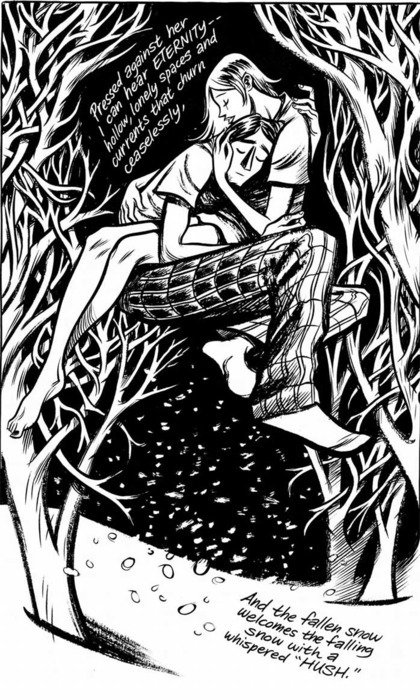
After Craig (the character, to distinguish from Thompson the author) and his girlfriend Raina spend a virginal if sexually-charged night together, Craig utters a small prayer, accompanied by the sleep tossed images of a beautiful girl who we know is Raina, but could very well be any girl; in the simple black and white illustrations I defy anyone to conclusively name her hair color:
Instead, he unfolds this love story, and in unfolding it he gives us glimpses into the traumas that have happened and are continuing to happen to both Craig and Raina. They are doomed but don't know it, and when the inevitable comes, it comes with an honest softness the opposite of the dramatic climax we expect from literature.
In Understanding Comics, Scott McCloud argues that ones of the choices the artists must make is his level of photo-realism. Most artists could, if they chose, fill their novels with precisely unique faces and bodies, making each page a photograph. But the human mind sees faces everywhere (that is why our emoticons work :-p ).
In Blankets, Thompson chooses to skirt a fine line, drawing his characters a little on the ambiguous side; they are clearly human, but who are they precisely? His character, thin-limbed, long faced and large nosed, could be him, judging by his photo on the back cover. But it could be a drawing of me, too. And that's where the magic begins.
| From here |
Pressed against herWhat I love about Blankets is how unassuming it is. There are lessons here: hard, painful, familiar lessons about growing up, about faith and parents, about the limits of authority and the limits of our ability to change the world- while Craig is endlessly unresolved about where his life should lead, Raina has already taken on the challenges of motherhood, stepping in with her sister's baby while the sister and husband indulge their materialistic side (they are, in fact, trying to distract themselves from the fact that their marriage will soon fall apart if they don't address their problems head on). But Thompson doesn't beat us over the head with any of those lessons.
I can hear ETERNITY--
hollow, lonely spaces and
creents that churn
ceaselessly,
And the fallen snow
welcomes the falling
snow with a
whispered "HUSH."
Instead, he unfolds this love story, and in unfolding it he gives us glimpses into the traumas that have happened and are continuing to happen to both Craig and Raina. They are doomed but don't know it, and when the inevitable comes, it comes with an honest softness the opposite of the dramatic climax we expect from literature.
Subscribe to:
Posts (Atom)