Monday, May 13, 2013

Review: Archeologists of Shadows by Lara Fuentes and Patricio Clarey

Is it despite or because of Archeologists of Shadows: The Resistance's slick graphics that it reminds me of a video game?

RPGs are one of my favorite forms, but they (almost) all follow the same trope: we, the heroes, dive into the world and are slowly introduced to its key elements. We are Neo, and we need a Morpheus to walk us slowly through the game mechanics. We are Frodo, lost if not for Strider's explanations  It's a trope underscoring one of the great weaknesses of science fiction- as the world becomes more unrecognizable, the author's impulse is to explain. And Archeologists is, at times, unrecognizable from the modern world, a cyberpunk alternative to The Matrix, where humanity has become the machines.

The really great works of science fiction simply pull us headfirst into the world, knowing we'll pick it up as we go along. For all of the (just) criticism leveled against George R. R. Martin's Song of Ice and Fire (sorry to have brought it up in successive posts), one thing it does well is trusting the reader to swim along in a cascade of information. This is why the story is so much more illuminating upon re-reading. Habibi, Ender's Game, Slaughterhouse Five; these books never really worry that the reader won't get it, they just plow on through.

Fuentes and Clarey strike a middle path. That the main characters of Archeologists of Shadows stumble through their world, finding just the right combination of wary but helpful strangers, nearly made me set the first volume aside. That their success appears to have been part of a more elaborate scheme by the hegemonic enemy sets up quite the Chekov's Gun. Either Fuentes and Clarey have a masterpiece or a dud; if there is a payoff waiting worthy of the immense cliffhangers provided by this first volume, this will be a series worth digging into.

Friday, May 10, 2013

Review: Akira by Katsuhiro Otomo

Of course, if you made it to the Open Mic, you already know what I've been re-reading.

I read a lot of memoirs in graphic novel form, and that is not what Katsuhiro Otomo's Akira is.

For all that made it groundbreaking in the 1980s (one of the first manga to be translated into English), volume one of Akira is also a throwback. The sound effects leap off the page like the old Batman live action tv show. The set-up is classic comic: young men, apparently still in school but independently resourceful enough to operate a drug dealing motorcycle gang, stumble their way into an adventure that unfolds slowly enough for them to figure out most of what's going on without any of main characters coming to serious harm.

Fandom has given a lot of attention to how numbing the violence becomes in George R. R. Martin's Song of Ice and Fire (and especially the novels after Game of Thrones). And while it's true (for me, at least) that I find it annoyingly disengaging to see Martin kill off major characters just as the readers have gotten to know them well enough to become attached, I also find it ridiculous to see multiple characters survive a dozen close calls within the span of a few hundred panels.

Because of this disinterest in the plot, I've never gotten around to buying volume two of Akira. But on re-reading, I found enough to like that I'm reconsidering my position. Especially in Otomo's framing and shading, and most especially in his speed lines, I find a lot to hold my attention on each page.

Friday, March 22, 2013

Review: Oryx and Crake by Margaret Atwood

On the same road trip when I listened to The Year of the Flood, I also listened to Margaret Atwood's Oryx and Crake.

Maybe it was too much dystopia, or maybe I just spent too much time in the car (hello Pittsburgh!), but Oryx and Crake wasn't as riveting.

A lot of my enjoyment of a book comes from the narrator. Even if I didn't always love both narrators of Year of the Flood, they were distinct, and the point of view shifted often enough to keep one voice from going stale. In Oryx and Crake, we have only the voice of Snowman, gone mad with loneliness and grief.

Having read Year of the Flood first, the fact that Snowman is the only narrator also tips the author's hand that there will be no other people in this book. Much more than Robinson Crusoe or The Shining, Oryx and Crake is about what it's like to be the last man on Earth.

Oryx and Crake also suffered from the prequel problem (since I listened to the two books out of order): there were plenty of mysteries in the first book, and they don't all have to be explained away. Trying to understand without knowing is a part of life, and it's a part of the best fiction. Many of the scenes in Oryx and Crake I would have been most willing to cut involved the development of the technology that was taken for granted in Year of the Flood like ChickieNobs and pigoons.

Much like knowing the ending to a mystery novel, knowing a piece of the ending sapped some of the joy from Oryx and Crake. I'm not sure what I was hoping for, but I'm sure I didn't get it.

Monday, March 18, 2013

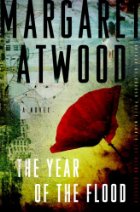
Review: Year of the Flood by Margaret Atwood

On a recent road trip, I brought along Margaret Atwood's stupendous The Year of the Flood unabridged audiobook. It was good- five star, top shelf, rave to your friends until they're sick of hearing about it good.

The Year of the Flood is about the end of the world. While the book's structure is divided between the time before and the time just after a pandemic that pushes the human race to the brink of extinction (the "waterless flood" the novel's religious zealots warn about), human life was over long before the disease's outbreak.

Atwood writes about people trying to build a life in the ruins of civilization. As power and wealth concentrates to the elite few, how do the rest of us forge a life? Can you get a decent job, find a decent place to live, raise a family? Through the eyes of two survivors, Toby and Ren, Atwood shows us a world in which the corrupting power of oligarchy's decadence and self-service rips civilization apart.