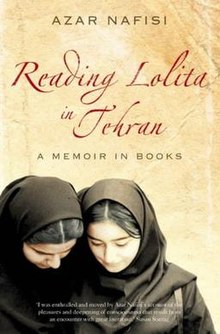
I dragged myself through Reading Lolita in Tehran by Azar Nafisi as part of the Freshman Reading Experience at the school where I work. The students I met with didn't even make it that far.
I wonder a lot about this book. The students Dr. Nafisi spend so much time with are obviously important to her. And, from a sociological standpoint, their struggle to create a personal space in the midst of one of the most oppressive regimes on Earth certainly has value.
But Dr. Nafisi's attempt to bring that struggle to life through the works of Nabokov, Fitzgerald, Austen and James left me cold. Reading Lolita in Tehran struggled to find its own identity- not quite enough about books and their ideas to captivate me, not quite enough a personal memoir to become open and accessible. Perhaps it is the most accessible book of its kind, but that is being damned by faint praise.
The thing RLiT lacked most was a definitive moment of choice. It was, instead, a study in the daily struggle of life in a totalitarian state. Of course, this makes it true in a way literature can rarely afford to be true. I think of Saul Bellow's Dangling Man as the distillation of the Superfluous Man, and in RLiT, Nafisi repeatedly refers to herself as "irrelevant," a superfluous woman in a country violently opposed to her kind of womanhood.
This lack of "moment" christalyzed into repetition and self-referentialism. Some of her stories are repeated with little variation. Some of her ideas (like her irrelevance) are referenced several times before they are expanded on and explained. While the book mostly flows forwards chronologically, it takes occasional leaps that make it difficult to follow.
It didn't help my experience that I listened to most of the book while taking a trip for work. The audiobook is atrocious; the narrator speaks so slowly that the less than 400 pages of the book take 16 hours to trudge through.
Wednesday, August 28, 2013
Friday, May 31, 2013
Review: A Matter of Life by Jeffrey Brown
When I was first discovering that there were graphic novels out there that dealt with real life, not superheroes and spandex, but everyday life, one of the best books I came across was Jeffrey Brown's Clumsy. That Clumsy was about the difficulties and awkwardness of long distance relationships a topic I know a little about, only made it feel more true.
So I was thrilled when the folks over at Top Shelf gave me to the chance to review Jeffrey Brown's A Matter of Life, which comes out next month.
A Matter of Life is about Brown's struggle with religion, his parent's faith and their refusal to reject him despite his rejection of faith. Where Craig Thompson's Blankets is about the breaking of relationships over faith (and, in that way, echoes Portrait of the Artist as a Young Man's bildungsroman), Brown's life never seems particularly ruffled by his decision. Of course, there is some tension and there are awkward moments. But on the whole, Brown's life is happy, good, normal. A normal life isn't usually best-seller material, but when the story is told as honestly as Brown tells it, normal life becomes compelling.
So I was thrilled when the folks over at Top Shelf gave me to the chance to review Jeffrey Brown's A Matter of Life, which comes out next month.
A Matter of Life is about Brown's struggle with religion, his parent's faith and their refusal to reject him despite his rejection of faith. Where Craig Thompson's Blankets is about the breaking of relationships over faith (and, in that way, echoes Portrait of the Artist as a Young Man's bildungsroman), Brown's life never seems particularly ruffled by his decision. Of course, there is some tension and there are awkward moments. But on the whole, Brown's life is happy, good, normal. A normal life isn't usually best-seller material, but when the story is told as honestly as Brown tells it, normal life becomes compelling.
Labels:
autobiography,
books,
graphic novels,
non-fiction,
reading,
topshelf
Thursday, May 23, 2013
Review: Ghost Map by Steven Johnson
Steven Johnson's Ghost Map was brilliant while it focused on the heart of its story: the unlikely collaboration between Dr. John Snow and the Reverend Henry Whitehead in combating London's recurring cholera outbreaks in the mid-nineteenth century.
Johnson steps deftly between the science and the sociology of the era; he explores the prejudices of the city's leaders, the moralistic and pseudo-religious views undermining theories about the spread of disease, and the technological advances accompanying London's transformation from an Elizabethan city to a modern metropolis.
Snow and Whitehead are fascinating men. A little bit Sherlock Holmes and a little bit Tetrius Lydgate, each provides the elbow grease that spurs a revolution in how we think about disease that can look, in retrospect, like the nexus of progress and good luck. Johnson shows us the hard work Snow and Whitehead put into their search for the cause and cure for cholera, which was for each of them, a consuming and noble hobby.
I recommend that story whole-heartedly.
Johnson steps deftly between the science and the sociology of the era; he explores the prejudices of the city's leaders, the moralistic and pseudo-religious views undermining theories about the spread of disease, and the technological advances accompanying London's transformation from an Elizabethan city to a modern metropolis.
Snow and Whitehead are fascinating men. A little bit Sherlock Holmes and a little bit Tetrius Lydgate, each provides the elbow grease that spurs a revolution in how we think about disease that can look, in retrospect, like the nexus of progress and good luck. Johnson shows us the hard work Snow and Whitehead put into their search for the cause and cure for cholera, which was for each of them, a consuming and noble hobby.
I recommend that story whole-heartedly.
Wednesday, May 1, 2013
Review: Marbles by Ellen Forney
Forney's pages have a rich variety. When framed, her pages are regularly three row, usually two column but occasionally mixing in a page-width row. When unframed, her images and words spill over each other. The more manic the scene, the more disordered the framing. My favorite image comes at the end of the third chapter- a sideview of a black drain, with an image sliding down one side. Is it water, or is it a three part liquified stick figure melting away? On one side of the drain is a long list of the negative side effects and risks of lithium use. On the other side is the sober reality that lithium wasn't the best drug for her at that moment. As a story teller, Forney balances her text-heavy tale with great, often brilliant black and white art.
Labels:
autobiography,
books,
graphic novels,
literature,
non-fiction,
reading
Thursday, April 18, 2013
Review: A Chance to Win by Jonathan Schuppe
When is a book about baseball not a baseball book?
When the book is Jonathan Schuppe's brilliantly realized A Chance to Win. What began as a feature article about a Little League team by a crime reporter turned into a tale of the long struggle to rebuild Newark, NJ. It's a story about the permanent underclass build by draconian drug laws, failed schools, and shattered families. It's a story about the shadow economy created by the shortfalls of the welfare state. Most of all, it's a story about how everyone involved in the generational tragedy that is Newark wants something better, but bereft of viable options, struggle to find a new path.
Rodney Mason is an ex-con, a part-time drug dealer, a onetime standout baseball player rendered paraplegic by a drive-by shooting, and coach of the South Ward Little League's Elizabeth Avenue Eagles.
Schuppe masterfully draws together the Eagles' story, as a Little League team and after. As he establishes a personal connection with Mason, the kids and their families, I couldn't help feeling just as drawn into the experience as he surely was. The families' successes are encouraging, their errors are deflating, and their struggle to stay focused on the future in the midst of a world where life is cheap is inspiring.
This is not the kind of feel-good book that will be made into a movie. The kids are poor. Only a couple have ever played baseball before; they come to their games without equipment and uniforms, and they come lugging all the baggage of poverty. But it's a book about the underdog's hope. It's a great read for spring.
A Chance to Win doesn't come out for sale until May 7th, but you need to put your order in today. It's the best piece of non-fiction you'll read this season.
When the book is Jonathan Schuppe's brilliantly realized A Chance to Win. What began as a feature article about a Little League team by a crime reporter turned into a tale of the long struggle to rebuild Newark, NJ. It's a story about the permanent underclass build by draconian drug laws, failed schools, and shattered families. It's a story about the shadow economy created by the shortfalls of the welfare state. Most of all, it's a story about how everyone involved in the generational tragedy that is Newark wants something better, but bereft of viable options, struggle to find a new path.
Rodney Mason is an ex-con, a part-time drug dealer, a onetime standout baseball player rendered paraplegic by a drive-by shooting, and coach of the South Ward Little League's Elizabeth Avenue Eagles.
Schuppe masterfully draws together the Eagles' story, as a Little League team and after. As he establishes a personal connection with Mason, the kids and their families, I couldn't help feeling just as drawn into the experience as he surely was. The families' successes are encouraging, their errors are deflating, and their struggle to stay focused on the future in the midst of a world where life is cheap is inspiring.
This is not the kind of feel-good book that will be made into a movie. The kids are poor. Only a couple have ever played baseball before; they come to their games without equipment and uniforms, and they come lugging all the baggage of poverty. But it's a book about the underdog's hope. It's a great read for spring.
A Chance to Win doesn't come out for sale until May 7th, but you need to put your order in today. It's the best piece of non-fiction you'll read this season.
Subscribe to:
Posts (Atom)


