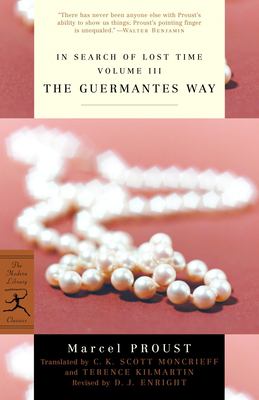
Would I have made it through The Guermantes Way without the plot synopsis and page reference numbers in the appendix?
More importantly, would the third book of Proust's In Search of Lost Time have scuttled my entire project to read his masterpiece?
The Guermantes Way was a bit like reading Leviticus (which I did in a different phase of self-abuse). It was dull, obsessively detailed, and light on characters. To be sure, Proust fills his book with important people, but they are people who were (I think) more important to the world outside the book or (I can hope) will be more important in later chapters.
The most valuable characters in this volume seem to be the grandmother, who does little but die and whose death doesn't impact the Narrator in quite the way I'd have hoped, and Albertine, who returns but is much less interesting than I found her in Within a Budding Grove.
Maybe my disappointment comes from growing to dislike the Narrator's social climbing and the incumbent attention to heritage. At the conclusion of The Guermantes Way, I certainly feel ready to write a screed against the bourgeois excesses of early 20th century France. These people are society, but they seem to do nothing, contribute nothing, and know nothing more than their own petty social caste.
And maybe my disappointment comes from the Narrator's growing dominance of the story arc. My favorite chapter to date has been "Swann in Love" from Swann's Way, and closely following it, the passages from the end of Within a Budding Grove featuring Albertine, Andree and Gisele. The Narrator needs to share the stage.
Sunday, December 29, 2013
Tuesday, December 17, 2013
Review: Monster on the Hill by Rob Harrell
In Monster on the Hill, Rob Harrell of Top Shelf has put together a story that is begging to be turned into a Pixar film.
The monster Rayburn isn't particularly excited about his job terrorizing the people of Stoker-on-Avon. But terror is big business in this Victorian world, and the town fathers enlist a local inventor to prod Ray into action. With a tag along urchin in tow, the trio set out to visit one of Ray's old school buddies to help restore Ray's self-confidence.
Unfortunately, while out of town, a real monster shows up. Ray and his friends must race back to Stoker-on-Avon to deal with the crisis.
A children's story with the right mix of morals and hijinx, my favorite part of Monster on the Hill was the brilliantly drawn world Ray and his friends inhabit. With bold colors and odd shapes, Harrell builds a Seuss-like world filled with quirks and just enough magic to keep the readers on their toes.
The monster Rayburn isn't particularly excited about his job terrorizing the people of Stoker-on-Avon. But terror is big business in this Victorian world, and the town fathers enlist a local inventor to prod Ray into action. With a tag along urchin in tow, the trio set out to visit one of Ray's old school buddies to help restore Ray's self-confidence.
Unfortunately, while out of town, a real monster shows up. Ray and his friends must race back to Stoker-on-Avon to deal with the crisis.
A children's story with the right mix of morals and hijinx, my favorite part of Monster on the Hill was the brilliantly drawn world Ray and his friends inhabit. With bold colors and odd shapes, Harrell builds a Seuss-like world filled with quirks and just enough magic to keep the readers on their toes.
Tuesday, October 1, 2013
On Fables and Poems
I've lost my copy of Rudyard Kipling's Just So Stories. Most likely, I've lent it to someone, said, "You have to read this, you'll love it." And it's gone. I need to replace it and re-read it myself.
In many ways, the Just So Stories are the quintessential fables- origin stories that also impart a lesson. How did the elephant get his trunk? Why, by being too nosey (get it?) about what the crocodile had for dinner.
I often think of good poems as fables- little encapsulations of a moment or a feeling. They have an arc, a moral, and (at their best) an impossible moment that just feels right. It is human life distilled to its most essential ingredients.
I think about Robert Frost's Birches, which is one of the poems I've re-read and re-listened to most in my life. The impossible moment is perfect:
I wonder who has my copy of Just So Stories. If I could remember, I could call them up and asked if they ever read it. I wonder if they love the stories' simplicity as much as I do?
In many ways, the Just So Stories are the quintessential fables- origin stories that also impart a lesson. How did the elephant get his trunk? Why, by being too nosey (get it?) about what the crocodile had for dinner.
I often think of good poems as fables- little encapsulations of a moment or a feeling. They have an arc, a moral, and (at their best) an impossible moment that just feels right. It is human life distilled to its most essential ingredients.
I think about Robert Frost's Birches, which is one of the poems I've re-read and re-listened to most in my life. The impossible moment is perfect:
Without this moment, Birches is an old man wishing to be young again- to swing from trees, to have the innocence to believe that the bent birches along the road were brought low by being swung from too often. But because of the plea "May no fate wilfully misunderstand me" this a poem about a man who recognizes that for all life's hardships, for all the broken ice and slow thaws, no life could be better than this one.
I'd like to get away from earth awhile And then come back to it and begin over. 50 May no fate wilfully misunderstand me And half grant what I wish and snatch me away Not to return. Earth's the right place for love: I don't know where it's likely to go better.
I wonder who has my copy of Just So Stories. If I could remember, I could call them up and asked if they ever read it. I wonder if they love the stories' simplicity as much as I do?
Thursday, July 11, 2013
Review: The Twits by Roald Dahl
Children's books have been a car ride staple for our last few road trips, and on our recent trip down to North Carolina, we brought along Roald Dahl's The Twits.
It's a story about a truly awful husband and wife, who torment each other with horrid pranks. They also keep a family of monkey's prisoner and force them to stand on their heads all day long.
The great moment comes early in the book- Mr. Twit convinces Mrs. Twit that she has "The Shrinks." By gluing extra lengths of wood to her cane and chair each day, he tricks her into believing she is shrinking- that her head is collapsing into her neck, her neck into her body, her body into her legs; and that all that will be left of her is her shoes. This is revealed to be a lie, and Mrs. Twit plots her own revenge.
At the end of the book, after all the tricks and plots and plans, the neighborhood birds team up to destroy the Twits. The birds do it by attaching all the Twits' furniture to the ceiling, convincing the Twits that they need to stand on their heads in order to get right-way up. Once the Twits are standing on their heads, they are crushed under their own weight- their heads collapse into their necks, necks into torso, torso into legs.
The axiom runs that we are what we repeated do, and the Twits constant evil brought that evilness back to them. It's the very definition of poetic justice. Plus it was laugh out loud funny.
It's a story about a truly awful husband and wife, who torment each other with horrid pranks. They also keep a family of monkey's prisoner and force them to stand on their heads all day long.
The great moment comes early in the book- Mr. Twit convinces Mrs. Twit that she has "The Shrinks." By gluing extra lengths of wood to her cane and chair each day, he tricks her into believing she is shrinking- that her head is collapsing into her neck, her neck into her body, her body into her legs; and that all that will be left of her is her shoes. This is revealed to be a lie, and Mrs. Twit plots her own revenge.
At the end of the book, after all the tricks and plots and plans, the neighborhood birds team up to destroy the Twits. The birds do it by attaching all the Twits' furniture to the ceiling, convincing the Twits that they need to stand on their heads in order to get right-way up. Once the Twits are standing on their heads, they are crushed under their own weight- their heads collapse into their necks, necks into torso, torso into legs.
The axiom runs that we are what we repeated do, and the Twits constant evil brought that evilness back to them. It's the very definition of poetic justice. Plus it was laugh out loud funny.
Subscribe to:
Posts (Atom)

