Thursday, September 12, 2013

Review: Nine Years Under by Sheri Booker

I spent a long time reading Sheri Booker's Nine Years Under, and now I've spent nearly as long thinking about what to say about it.

from here
Booker's prose is fluid and engaging. Her promise as a writer is immense, but her story didn't engage me the way I wanted it to. Maybe because I read A Chance to Win, and it is such a great book about inner city life, that I wished for too much from Booker.

First, she has the disadvantage of being a memoirist and limited to her own story, as opposed to a reporter/ biographer who has multiple story lines to choose from.

Second, perhaps Booker's publicist did her a disservice by promising
With AIDS and gang violence threatening to wipe out a generation of black men, Wylie was never short on business. As families came together to bury one of their own, Booker was privy to their most intimate moments of grief and despair. But along with the sadness, Booker encountered moments of dark humor: brawls between mistresses and widows, and car crashes at McDonald’s with dead bodies in tow. While she never got over her terror of the embalming room, Booker learned to expect the unexpected and to never, ever cry.
While all those things are evident in Booker's memoir, they never feel like they take center stage; they are scenery, but the play is about a young girl struggling through the process of growing up, through having and leaving a beloved first job.

What was most missing from Nine Years Under was what I thought was its most obvious angle: Booker's parents. Her mother appears as half a character; she is her cancer, appearing only in horrid cycles of remission and recurrence. Her father is a presence but not a character. He's a Baltimore cop who can't watch The Wire because it hits too close to home, who has dedicated his life to make sure his daughter makes it out. But he never speaks, never offers advice or counsel.

Without her family, the characters of her life are limited to the funeral home's major players. But their interactions seem too limited to truly fill the surrogate family roles Booker assigns them. What was perhaps a compelling story in a 10,000 word magazine feature because drawn out and overwrought in a 300 page memoir.

Perhaps, in another few years, we'll see a second installment from Booker. I'd read it.

Wednesday, August 28, 2013

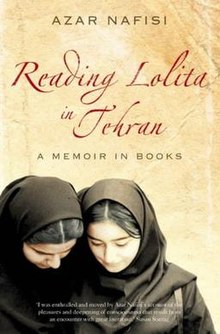
Reading Lolita in Tehran by Azar Nafisi

I dragged myself through Reading Lolita in Tehran by Azar Nafisi as part of the Freshman Reading Experience at the school where I work. The students I met with didn't even make it that far.

I wonder a lot about this book. The students Dr. Nafisi spend so much time with are obviously important to her. And, from a sociological standpoint, their struggle to create a personal space in the midst of one of the most oppressive regimes on Earth certainly has value.

But Dr. Nafisi's attempt to bring that struggle to life through the works of Nabokov, Fitzgerald, Austen and James left me cold. Reading Lolita in Tehran struggled to find its own identity- not quite enough about books and their ideas to captivate me, not quite enough a personal memoir to become open and accessible. Perhaps it is the most accessible book of its kind, but that is being damned by faint praise.

The thing RLiT  lacked most was a definitive moment of choice. It was, instead, a study in the daily struggle of life in a totalitarian state. Of course, this makes it true in a way literature can rarely afford to be true. I think of Saul Bellow's Dangling Man as the distillation of the Superfluous Man, and in RLiT, Nafisi repeatedly refers to herself as "irrelevant," a superfluous woman in a country violently opposed to her kind of womanhood.

This lack of "moment" christalyzed into repetition and self-referentialism. Some of her stories are repeated with little variation. Some of her ideas (like her irrelevance) are referenced several times before they are expanded on and explained. While the book mostly flows forwards chronologically, it takes occasional leaps that make it difficult to follow.

It didn't help my experience that I listened to most of the book while taking a trip for work. The audiobook is atrocious; the narrator speaks so slowly that the less than 400 pages of the book take 16 hours to trudge through.