Monday, January 30, 2012

Book 4 of 52: Breakfast of Champions

I would write about life. Every person would be exactly as important as any other. All facts would also be given equal weightiness. Nothing would be left out. Let others bring order to chaos. I would bring chaos to order, instead, which I think I have done. If all writers would do that, then perhaps citizens not in the literary trades will understand that there is no order in the world around us, that we must adapt ourselves to the requirements of chaos instead. It is hard to adapt to chaos, but it can be done. I am living proof of that: It can be done.
 Breakfast of Champions
I find this to be the funny truth about re-reading fiction: the work tells us much more about who we were and who we are than the text can convey in a vacuum. This is why I now enjoy going back to my favorites, something I never did when I was younger. Like a visit with old friends, it marks the passage of time.

Breakfast of Champions was never my favorite Kurt Vonnegut novel. I remember a spring and summer when my best friend and I raced through everything of Vonnegut's we could get our hands on. I think that between us we read close to all of Vonnegut's major works, comparing notes, deciding to skip this one or to move that one up the queue. Compared to his best, (I'd say: Slaughterhouse Five [of course], Bluebeard, and Cat's Cradle), Breakfast of Champions is sloppy, repetitive, and missing the 'it' that drives us through his better works. Of no help is the fact that nearly all the characters in Breakfast of Champions appear in other Vonnegut books; they are all more fleshed out, better interesting, and more engaging in their proper places than in this mash-up. Breakfast of Champions is very introspective, depending largely on first-person omniscient narration, though that introspection feels a little like solipsism if we don't know what the author is up to.

Of course, Vonnegut holds out on us in this book. He doesn't tell us what he's up to (creating chaos from the usually orderly writing process) until nearly the climax of the novel. In the decade since I read it last, I'd forgotten that part of Breakfast of Champions, so I arrived at it as a new surprise.

I'm sure I was too young, too unobservant to detect the meta-textual trail of breadcrumbs running through this book when I first read it. Vonnegut is a character in the book, writing the prologue and serving as the narrator. As the narrator, we watch him write a story in which he appears (again?) as a character. He states several time that this book serves as his fiftieth birthday present to himself, and reading it is, at times, like visiting a friend, then discussing the self-portrait that the friend has painted, framed and hung over his own mantle.

Friday, January 27, 2012

Happy Friday!

Survive the day, survive
then drive 300 miles
to the Carousel Capital of the World
to the shining Southern Tier
for beer and board games
and for the smiling of smiles.

Thursday, January 26, 2012

Board Games I Love: Samurai Swords

In some ways, it's unfair to claim to love Samurai Swords because I've played it fewer than a dozen times in my life.

I tend to think of board games (really meaning all tabletop games as distinct from video and computer games) sharing a few broad characteristics.

1) Complexity
2) Replayability
3) Strategy v. Luck
4) Interaction with other players
5) Zero-sum v. Cumulative score

My all time favorite games, including chess, Settlers of Catan, and Dominion all feature oodles of all four. Chess, my favorite pasttime, is both intensely complex and entirely dependent on interaction with the other player. It is one of the few truly complex games with no luck involved. The thing I love about chess is that if you win or if you lose, the pride or the disappointment are entirely yours to own.

The other two games I've mentioned depend on some luck; Catan is played with two six sided dice, while Dominion is a card game so the order after a shuffle determines everything.

I'm a fan of less luck, more skill games. I also, generally, prefer cumulative score games like Catan (where play continues until someone reaches 10 victory points) over zero-sum games like Monopoly where play continues until one player has taken all resources away from the other players.

I'm currently addicted to an old and wonderful board game called Samurai Swords (alternatively sold as Shogun or Ikusa, the owners have known they have a great game but the marketing obviously escaped them). It's a Milton Bradley Gamemaster game, so it's layout and basics compare to Risk and to Axis and Allies.

But Samurai Swords is to Risk as calculus is to the multiplication table. Instead of receiving troops for ownership of land, the player receives money ("koku") that he can then spend on different kinds of troops (1 koku buys a bowman, or 2 samurai, or 2 gunners, or 3 spearmen), on mercenary ronin, on the ninja assassin, on building fortresses, or on choosing when in the player order he wants to take his turn.

Fantastic.

The downside I'm struggling with right now is the luck involved in victory. Each of the different units has a different chance of scoring a "hit" on a twelve sided die. While each player builds his army, and thereby determines it's quality, critical battles can turn on a couple lucky rolls. Unbelievable last stands are not as common as in Risk (the defender has no die-based advantage in Samurai Swords), but ambition thwarting surprises still abound.

How many rolls of a twelve sided die are necessary to achieve a significant sample size? How many battles would have to occur from a moment of resource equality in order to be fairly confident that player skill, not luck, have determined the outcome? When has a player crossed the threshold of defeat, the point at which the odds of mounting a comeback become impossible given his current resources?

Sunday, January 22, 2012

Accidental Sushi

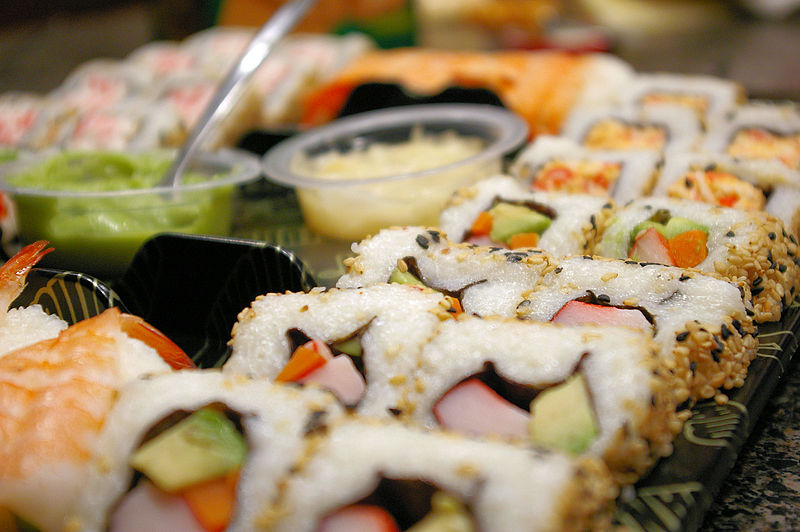
This is not the sushi I ate, but it looks yummy, too!
We didn't mean to have sushi for lunch yesterday, although it was quite good.

We stopped at Ichiban, just on the Eastern Shore side of the Bay Bridge. I have loved sushi ever since a friend introduced me to it (in Scranton PA, of all the landlocked places in the world). We don't have a sushi restaurant closer than 45 minutes from us here, and that's the farthest I've lived from a decent sushi place since I moved to Scranton 5 years ago.

So, here's how I went from Electric City to Ichiban:

1) I learned to love sushi through my love of a deal and love of a meal, and, since the nice sushi place in Scranton offered half price rolls on Sundays, it quickly became my favorite meal deal.

2) I moved all over the place (seriously, 4 times in 5 years, each time moving no less than 150 miles). I kept trying more kinds of sushi; I kept liking it in restaurant after restaurant and town after town.

3) I agreed to go to Baltimore for a friend's birthday, for ice skating and a wine bar, for joy.

4) It snowed.

I suppose the correct term for what happened between Friday night and Saturday morning would be 'wintery mix,' but it's not at all satisfying to say "4) It wintery mixed."

Baltimore didn't happen because traffic did, snarling the Bay Bridge. We didn't make it to the rink or the wine bar. But I did get a fantastic $9.99 lunch special, 4 rolls, and Carol got a bento box. I had tuna and salmon, spicy red snapper, and eel and avocado.

Not the day I expected, but a yummy one nonetheless.

Friday, January 20, 2012

Required Reading for Everybody

Cannery Row at IndieBound
Rebecca Joines Schinsky, of the Book Lady's Blog, suggests required reading for everybody as a cure for what ails us. Leaving aside logistical questions of translation, publication, distribution and follow-up: imagine going anywhere in the world, meeting entirely new people, and already having in common at least one thing, that we've read the same book.


As a thought exercise, it appeals to me a lot. Which is, of course, why I'm sharing it here.


What would you ask the entire world to read? In bedrooms and living rooms and classrooms around the world, 7 billion people are grappling with the same series of words, of thoughts.


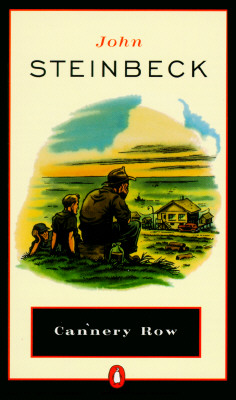
I think I would begin with John Steinbeck's Cannery Row. It's a sweet and simple book, about how a community grows when people begin to work past their first reaction and find the good in each other. It's about building a better world by being a little happier in the world we're in. I think it is the story of a quiet revolution, because the characters (without ever meaning to, or setting out to, or even fulling comprehending what they've done) transform their little corner of Monterey into something like a functional community through a strength of spirit which, we understand, the rest of the town and the world lacks.

It's been a few years since I re-read it. I need to pick it up.


Where would you start?

Happy Friday!


Got to get through today.
Tomorrow brings a birthday in Baltimore.
Sunday means baseball in C-town, and maybe some board games on Greenwood.
But I've got to get through today-
The looming desk, the manila cascade.

Tuesday, January 17, 2012

Book 3 of 52: Lost at Sea

Bryan Lee O'Malley is best known as the author of the Scott Pilgrim series, and while I haven't read that yet, plenty of people whose opinions I trust have given him a thumbs up.

So, when I saw Lost at Sea on a bookshelf during a recent trip back to New Jersey, I couldn't let the moment pass.

Seizing the moment, even if the whys and hows are frighteningly undefined, is precisely the cure-all that O'Malley prescribed in his debut graphic novel.

The plot is simple: Raleigh is returning home to Vancouver from visiting her father and his new girlfriend in California; while stateside, she snuck in a visit to her boyfriend, whom she had previously met over the internet. She misses her train, but lucks into a ride home with some kids who attended her private high school.

I could sum up a number of other novels this way. The Old Man and the Sea is about an old fisherman who hasn't caught a fish in a long time, sails out farther than is probably wise, and catches the biggest fish of his life. He kills it, but on the ride back to the harbor the fish is torn apart by sharks.

We, the readers, are Raleigh's boyfriend (Stillman), and the narrative takes the form of a story being told to us; Raleigh's voiceover fluctuates between the past and present tense, for reasons that become clear as the story progresses. This is a bildungsroman, and it carries with it all the pitfalls of a coming-of-age novel. Raleigh skirts what a more famous first person narrator referred to as "all that David Copperfield kind of crap," instead unfolding her backstory in (what she feels are) the tedious pauses of the current moment.

"I've been on the road with them for maybe two hours, and every minute has been just like this-" 2 pages of panels depicting the long judging looks that teenage girls can give each other when they each think they know what the other is thinking "-longer and hotter and smaller and darker and more claustrophobic and so so so much worse in comparison."

O'Malley's artwork adds to the feeling of claustrophobia: his characters exist as flat sketches of white and grey against white or black backgrounds. His text, too, is rigidly handwritten: white against black or black against white; almost always uniform size and style; almost always perfectly perpendicular to the page.

From this rigidity, Raleigh's backstory comes bursting out. She charts the tensions, expectations, and fears that drive her into herself. It takes days of travel in a direction that might be toward home, and a chance encounter that may be a prophecy fulfilled or deja vu or memory or fate, to push Raleigh to confront her anxieties.

Unlike so many coming-of-age stories that disappoint me by pulling together every loose end, Lost at Sea leaves nearly every concrete question unanswered, in favor of answering the ontological questions of looming adulthood. I don't think it's a terrible spoiler to say that the answer involves embracing the moment, and the people who come to the moment with you.